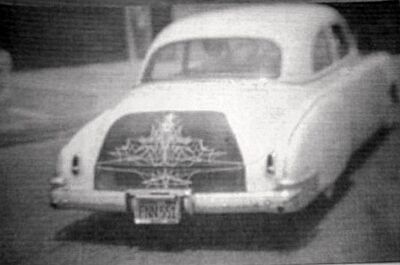
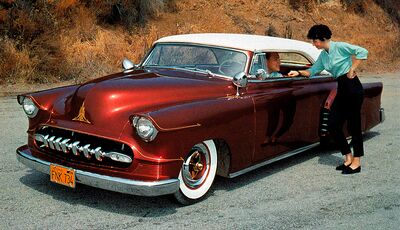
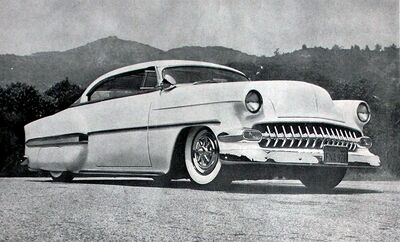
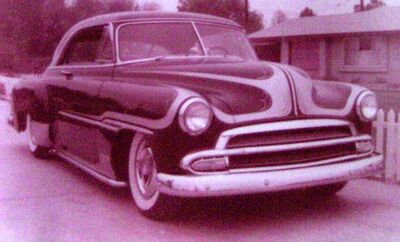
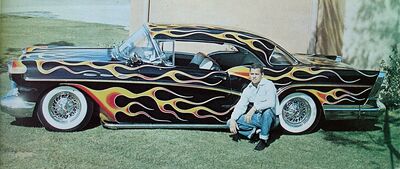
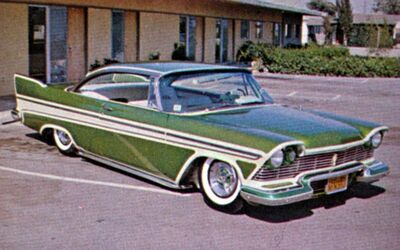
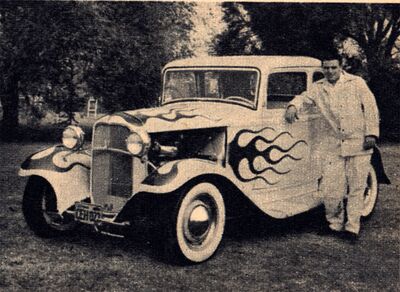
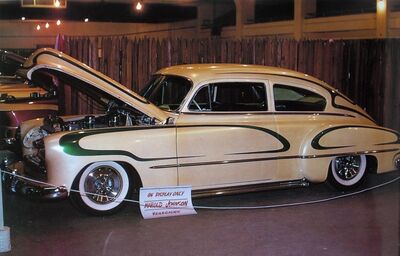
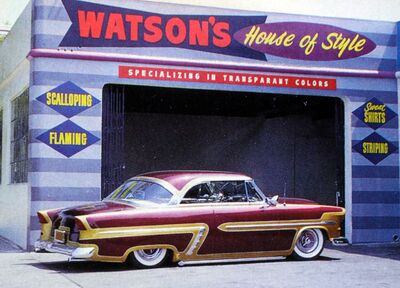
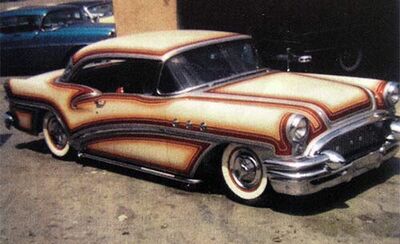
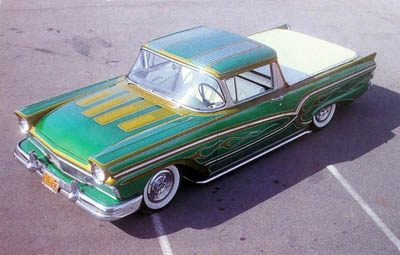
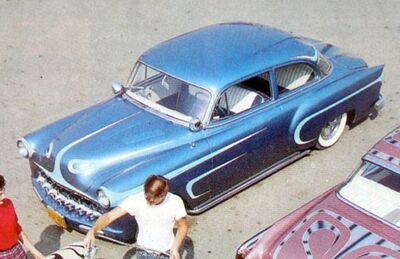
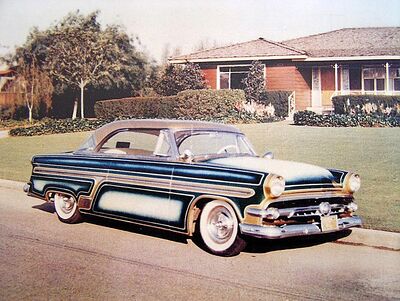
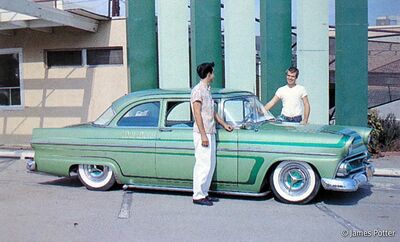
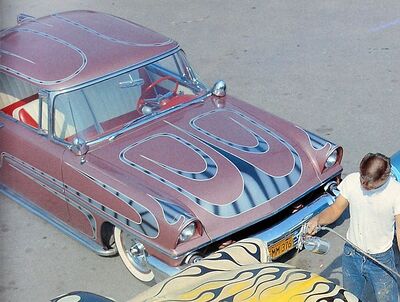
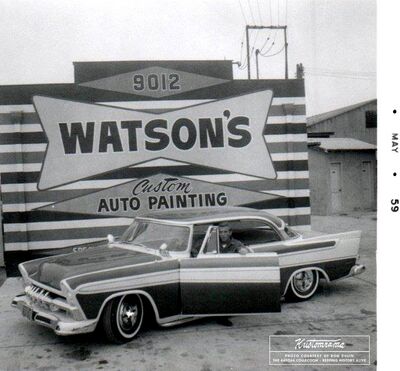
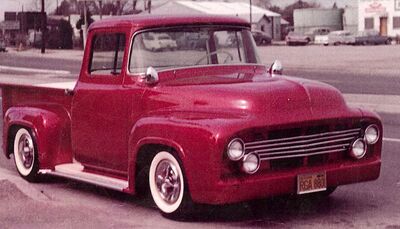
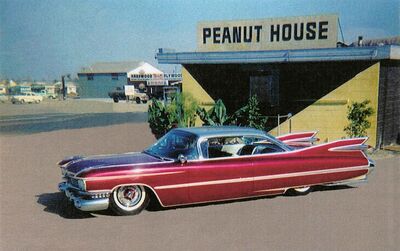
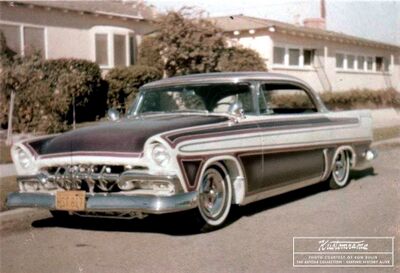
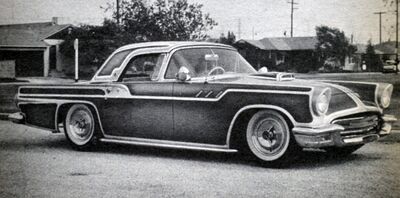
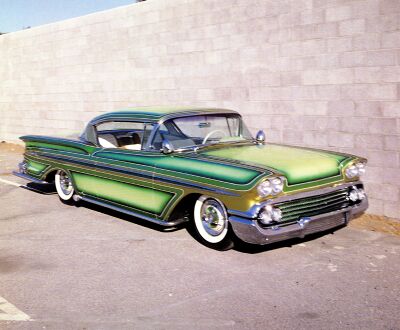
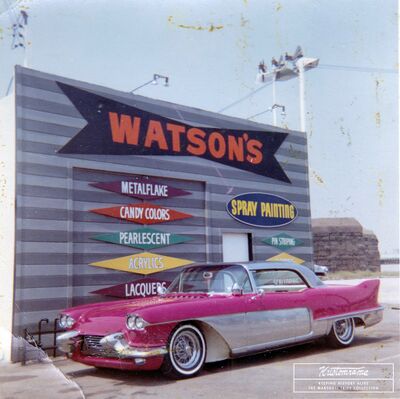
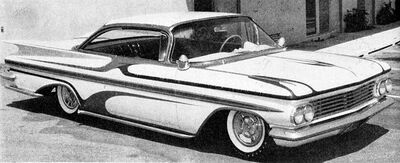
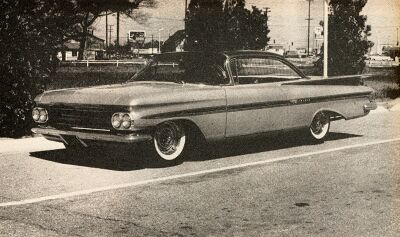
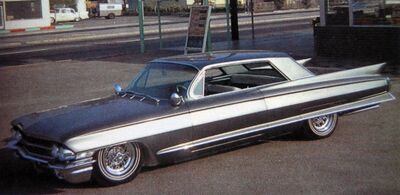
Watson's House of Style was a custom paint shop run by legendary custom painter Larry Watson. Over the years, Larry ran his shop from different locations.
Upon graduating from school in September of 1957, Larry opened his first paint shop. Keith Christensen remembers him in his youth, without a beard or styled hair, moving into a building directly across the shop area from his original Gene's Mufflers shop in Paramount. "There he took on his aura of beard and styled hair," Keith told Sondre Kvipt of Kustomrama in 2020. Keith recalled Watson first opening up a little shop close to Nance Chevrolet company on Bellflower Blvd in Bellflower. "He started painting cars,"Keith recalled. "He would wet down the floor of an old garage for the sake of dust, and painted inside. It wasn't long before the fire department came and close him down." In May of 2020Roger O'Dell told Sondre that the exact location of Larry's first shop was on Palm Street, where the 91 freeway westbound off-ramp for Bellfower Blvd is today. "The shop area is buried under the off ramp." Roger recalled Nance Chevrolet being located at 17046 Bellflower Blvd., on the corner of Bellflower and Park Street. Later on, Clutch & Gear was located in the Nance Chevrolet spot on Park Street. Bob Williams and Jerry opened up Clutch & Gear after leaving Stu's Transmission in Long Beach. In 2020 it was a bank on Bellflower Blvd., and on Park Street, the area where Clutch & Gear was. "Palm Street, south of Park Street, east of Bellflower Blvd. the part that used to run into Bellflower Blvd. is now a freeway off-ramp, and Palm is a dead end."[3]
Keith remembers Watson then moving over on to Park street in another small garage where he went through the same scenario. "From there he moved in next to my shop on Lakewood Blvd, in Paramount, across the street from the border of Bellflower. He had a group of back yarder's come in and install an old paint booth he had found and bought." Watson was finally legal, and Keith remembers him advancing from a few custom paint jobs to Candy paint and onto gorgeous pearls.[5]
Customizing with paint
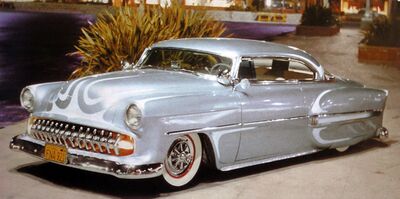
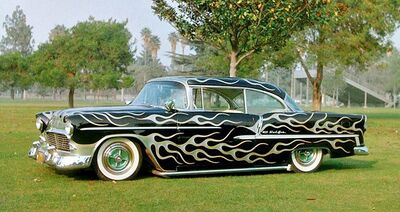
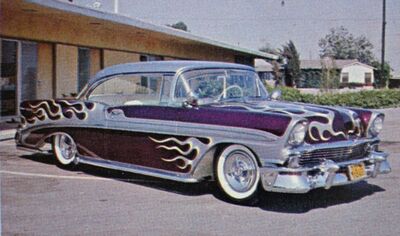
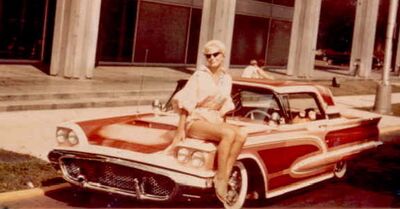
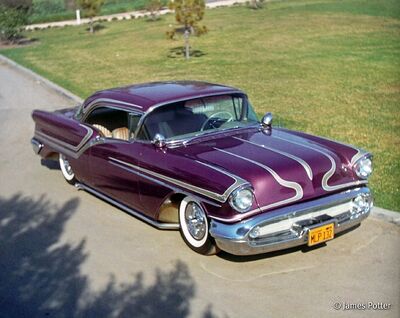
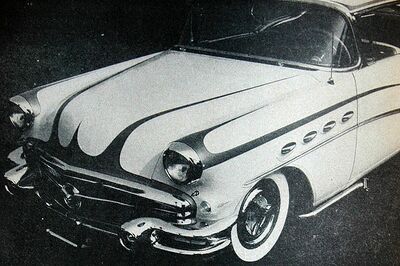
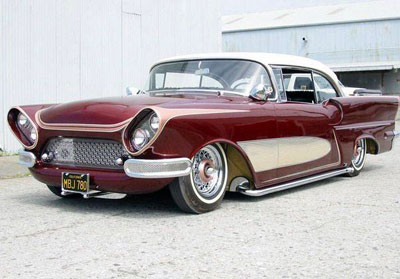
In order to promote his brand new shop, Larry bought a brand new 1958 Ford Thunderbird that he took to Barris Kustoms for som mild modifications. Bill Hines and Bill DeCarr that worked at Barris Kustoms nosed and decked the car, shaved the handles and rounded the corners. After that Larry painted the car with six coats of pearl over a fine metallic silver base. Larry didn't tint the pearl with transparent mixing black toner that eliminated the cloudiness, and he thought the car turned out too bright. Larry thought the bright look made the car look way too large, so in order to fix it up, Larry taped the panel lines of the bird with 1-3/4 inch tape and shot candy apple burgundy over it. With this paint job many thinks that Larry invented the Panel Paint Job. The Thunderbird was the first car featuring a silver pearl and candy burgundy paint job, but before he painted panels on his own car he had already paneled Zeno Stephens' 1955 Mercury. Zeno wanted something different, no scallops or flames, so Larry body paneled it. Larry painted the car in Titian Red and striped it in gold. After painting the car Larry never saw it again, not in a magazine, or at a car show, nowhere.[6]
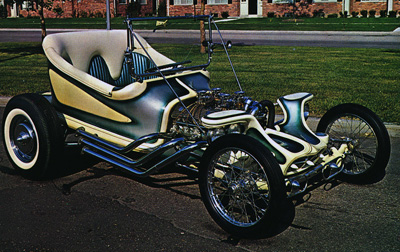
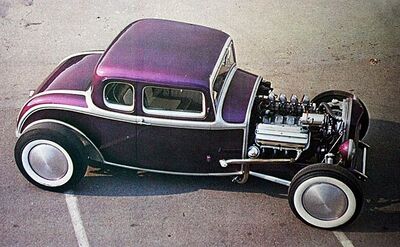
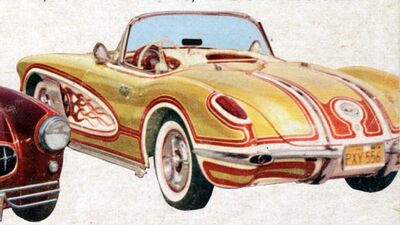
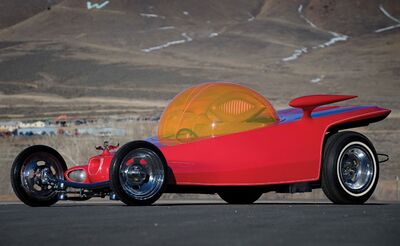
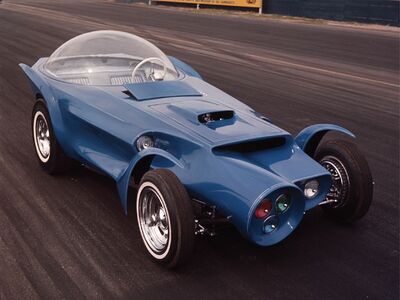
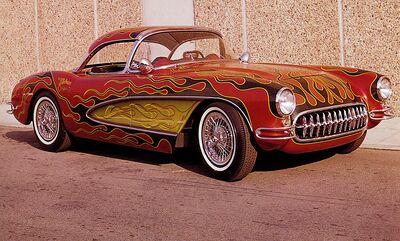
In 1960 Larry applied his first Metalflake job on Ron Aguirre's Corvette, the X-Sonic. The X-Sonic did also feature Watsons first fade paint job. As Aguirre kept modifying the car, Watson painted it six times. As Larry matured, he became the great painter that everyone would recognize. "In the early 1960s he started innovating painting. From flames, to blending of colors, to two tones of the very expensive Murano pearl, which at that time was made up of abalone seashells blended into the paint. It was astonishing what he developed and did," Keith Christensen recalled in 2020.[5] In his book, The American Custom Car, Pat Ganahl also claims that Larry got a little tired of all the masking and striping between 1960 and 1966, and he started doing mostly straight candies with Metalflake or Pearl tops, or Pearl bottoms with matching Candy tops.[7] Larry was kicking ass working anything from 12 to 20 hours a day, 7 days a week. He had 5 or 6 helpers.[6]
According to Dave Ellis, who worked for Watson at the Lakewood Boulevard and Artesia Boulevard shop color-sanding cars, Watson installed a payphone in his shop office because people kept using his business phone for personal calls.[4]
Between 1960 and 1966 Larry got tired of all the masking and striping, and he started doing mostly straight candies with Metalflake or Pearl tops, or Pearl bottoms with matching Candy tops.[7] Larry was kicking ass working from 12 to 20 hours a day, 7 days a week. He had 5 or 6 helpers.[6] At the peak in 1966, Larry sold the shop he had on Lakewood Boulevard in Paramount, and moved to Mexico in order to pursue an acting career with his wife.
After Watson left his shop in Paramount, a custom car painter named Larry Craig eventually moved into the building across the driveway from Gene's Muffler.[4]
While the Cat's Away
When Watson moved to Mexico he left behind a big gap in the market, and while he was away, two other "Watson" custom paint shops sprung up in the area offering custom paint jobs to teenagers that didn't know better. One of the shops, Watson's Custom Kars was located in Downey. The other one, Watson's was located in Van Nuys on Burbank Blvd.
The Comeback
Late in 1966 Larry returned to California to open up a new shop in Bellflower. The new shop was located on 17412 Lakewood Blvd., on the corner of Artesia. Back in business, Watson made flyers that contained an important notice about the imposters that had been using his name while he was away; "Larry Watson is not associated with Watson's Custom Kars in Downey and the Watson's in Van Nuys on Burbank Blvd. - And - Disclaims all responsibility of work coming from those locations. To whom it may concern! It's only a Watson Paint Job when Larry Watson does the painting personally." Marshall Tripp worked for Larry between 1966 and 1967. At the time Ken McGoldbrick was the manager in the shop. In 2016 Marshall told Kustomrama that "Kenny was the "manager," although Larry was always there. He was a good guy and knew his stuff when it came to Larry's work. He taught me how things should be done." Marshall remembers that Joe Perez did Watson's interiors while he worked for him; "I remember Watson saying once "you'll never win best interior with black.""[8]
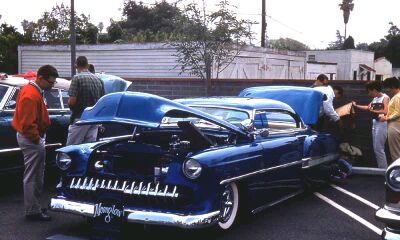
After Larry had opened up the shop in Bellflower, he determined that he had to get his name back on the show circuit,, so he decided to do something completely new for the upcoming show at the Los Angeles Sports Arena in April 1967. Larry was painting Doug Carney's 1963 Pontiac Grand Prix for the show, and decided to do a lace paint job on the car. Ha had never tried the technique before, but Von Dutch had told him about a doily that ha had on a bench in his shop. One day while cleaning up in the shop he had removed the doily, and a beautiful overspray pattern had been left on the bench. Von Dutch dug the design and painted clear all over it. While wondering about what to do with Doug's Pontiac, Larry remembered this story, and decided to painty the whole side of the car using a lace pattern with Lucky Lage Duble X Pattern. Many believes that custom painter Joe Andersen invented the technique as he demonstrated it in the Rod & Custom March 1968 issue, one year after Larry painted Doug's Pontiac.[7] Larry's newly painted Pontiac made it's debut at the April 1967 show together with 53 other cars in the center arena of the car show, who was sponsored by the Tridents Car Club. At the same show he also had over two dozen motorcycles upstairs.[6]
"Lacing the sides of a car was marvelous," Keith Christensen recalled, "as seen on Doug Carney's 1963 Pontiac. I helped Larry with a couple of lacing jobs. We would set up saw horses on either side of the car and have to position them perfectly - just inches away from the side of the car - tedious and critical. Then we would take an expensive lace table cloth and stretch it between the sawhorses - even more critical a distance. This is all after the car had just been painted some wild Candy or Pearl." The finesse of the next step was the crucial step, Keith remembered; "Larry had only one pass along the side of the car to fog through the lace. He would take a beautiful paint color and turn the pressure of the paint gun up and walk the full length of the car in one long smooth, balanced sweep. A real test of talent as Larry would not have a second chance, as the paint would fog through the lace tablecloth and onto the side of the car and had to land perfectly and equally - No second chance. If it was not perfect, the whole side of the car had to have the lacing fog taken off." According to Keith, "Larry's intricate preparation and his talent came out in all this. The paint jobs were the talk of the town and won awards at a lot of car shows."[5]
After the 1967 Tridents Rod Custom Autorama Watson he figured that he couldn't get any further, so he decided to sell his shop and get out of the business.[6] He left the custom car scene in favor of a blossoming TV and movie acting career. Larry joined the Theater Actors Guild and started getting small non-speaking parts in many movies. Keith Christensen recalled that while he was still next to his shop in Paramount, he got a small part in Ben Hur, and when he came back to his ship, he and one of his workers were wearing regalia from the movie. "This I feel, fueled and motivated him to go further with acting. He associated himself with Norm Grabowski." Keith believed Larry learned the rope from him. "His big break came when he was introduced to Mike Conners of the TV series "Mannix." Mike's family liked Larry and he started getting a lot of bit parts and finally a one-line speaking part. Larry used to show me some of his residual checks from the Actors Guild and he was proud of the passive income they represented."[5]
New Shop. New clientele. The same labor-intense perfect paint jobs
Larry painted and striped numerous luxury or sports cars for actors, actresses, directors, producers, or casting directors to gain entree. Keith Christensen would periodically visit Larry at his Hollywood shop. "It was quite a different atmosphere," Keith told Kustomrama in November of 2020. "Different divergent customers of all nationalities, ages, and wealth." Larry had the typical hang arounds and workers, and Keith recalled that it was a big challenge for him to find any help in prepping a car, "which I have mentioned before, is 70% of the quality of a paint job." Larry initially painted thru contacts he had made while getting non-speaking parts in movies. "He developed many friends and customers, and one of his biggest friends and contact was Mike Conners. He befriended Larry and gave him many small, non-speaking roles in many episodes in that long-running series." Mike sent Watson a lot of paintwork on fellow actors' cars. "Larry painted Lucille Ball's Rolls Royce a beautiful pearl pink. He also painted Sammy Davis's Jaguar XKE a beautiful Murano pearl yellow. I saw both cars in process on one of my many visits to the Hollywood shop. They were perfect, pristine, and really stood out. Larry's demand for quality showed in both of them. Again I say, he had a hard time finding anyone to sand and mask a car, as it was labor-intense and had to be done perfect! When preparing a car to be painted, in the majority of the time, chrome strips had to be removed, bumpers taken off as well as rearview mirrors and headlight rings. Very tedious! Any masking paper that was, by accident put on to the paint area, rather than where it was covering, would leave the other, original color of the car showing. Larry was a tyrant of sorts and a great teacher to all of his workers. He did, however, produce some of the most beautiful paint jobs of that era. The cars were sanded 3 times during the paint job. This would remove any blemishes, any scratches, and of course, orange peel, which is like an orange with many little valleys."[5]
Keith watched Larry lay down several paint jobs, and he recalled that when it started, the base, the reflective color was put on by Larry, "then the car would leave the paint booth and outside it would be color sanded with a very fine-grit sandpaper. Then back into the booth for many rounds of spraying on the finished color. Quite often with a candy color, the base coat had to show thru. The number of times Larry walked around the car applying coat after coat," and this is where Larry shined, according to Keith; "He could tell, in the painting rounds, just how far to go. Then, out of the booth again, and again, the car was color sanded for hours at a time to make this final coat like a mirror. Once more after making sure non of the tape had come off, the car went back into the booth. Larry, would then, put the protective coat of clear paint over the top of the gorgeous color. Many rounds he would walk around the car applying the clear. As a finale, this new clear coat was color sanded to the highest of smooth finishes. All of this was very hard work and a lot of talent. I can personally remember Larry at his Paramount, California shop, taking a car out of the paint booth and having his workers completely strip off the paint he just applied, as it didn't satisfy what he felt it should look like. WOW, a person speaks of labor intense, this was the epitome of it..."[5]
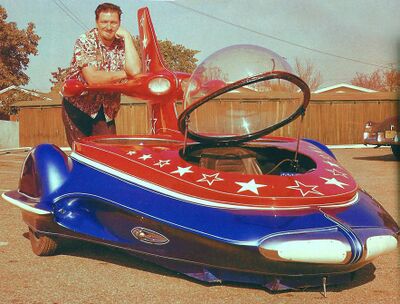
In the early 1970s, David Mirsky was a neighborhood kid that worked for Larry part time at his shop on Santa Monica Blvd in West Hollywood, and at his Melrose Avenue shop in Hollywood. David was one of those kids that hung around Larry's shop, that after a while was put to work. He was around 15 or 16 years old at the time, and Larry used him to take parts of cars, prep them for work and paint, color sanding and all sorts of other tasks. He was paid in hamburgers and fun, and he recalls working on Evel Knievel's jet bike, something that was really cool for a 15 years old kid. To David and his friends, Larry was the coolest guy they had ever met. He was a magician with cars and a good looking guy always looking for acting gigs. To David, Larry was who Burt Reynolds copied himself after. David remembers that Larry always had a slim cigar in his hands. He used the cigar like a prop when he made his points. David worked for Larry for a short period of time, and he remembers him as a good guy that always treated him as a friend. Larry painted a Bell Star helmet for David in 1971 that he still owned in 2013.[9]
The Paint Booth
In the late 1970s Larry Watson worked on a movie he wanted to produce called "The Paint Booth". Working for the movie he visited car shows handing out flyers on cars he wanted to use in the movie. For the movie Larry was looking for racers, hot rods, customs, and stocks 1956 or older. The backside of the flyer shows a print of Larry's business card. On that card he promotes his business as "Watson's Custom Auto Painting", Since 1955. His shop was located at 5576 Melrose in Hollywood. On a later business card he had changed the name to "Theatrical Auto Body", Complete Auto Painting Since 1969. The shop was still located at 5576 Melrose Avenue in Hollywood.[10]
Please get in touch with us at mail@kustomrama.com if you have additional information or photos to share about Watson's House of Style.
This article was made possible by:
SunTec Auto Glass - Auto Glass Services on Vintage and Classic Cars
Finding a replacement windshield, back or side glass can be a difficult task when restoring your vintage or custom classic car. It doesn't have to be though now with auto glass specialist companies like www.suntecautoglass.com. They can source OEM or OEM-equivalent glass for older makes/models; which will ensure a proper fit every time. Check them out for more details!